Mini bike pumps, ten name the valve and ten name neither
The short answer
Prices in GBPUSDEUReach row carries the day it was read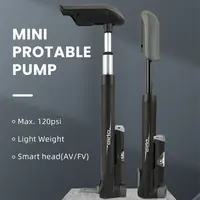


Twenty mini hand pumps for a bicycle, the kind that clips to a frame or lives in a bag. Nothing here has been handled; this is what twenty listings from one search do and do not tell you.
Ten of them name the valve. Ten name neither. Not one names only one.
The valve is the whole thing, and it is not a preference
There are two valves in common use and they are not interchangeable.
Schrader is the fat one with a pin down the middle. It is what a car tyre has, and what most hybrids, kids’ bikes and cheaper mountain bikes have.
Presta is the thin threaded one with a little nut you unscrew before you can pump. Road bikes have it, and so do most decent mountain bikes, because a narrower hole is kinder to a narrow rim.
Get this wrong and the pump is not a worse pump, it is a useless one. Which is why it is odd that half of this shelf does not mention it.
| What the twenty titles say | How many |
|---|---|
| Names both Presta and Schrader | 10 |
| Names exactly one of them | 0 |
| Names neither | 10 |
| Gives a pressure in PSI | 9 |
| Has a gauge | 3 |
| Says mountain or MTB | 13 |
| Says road | 14 |
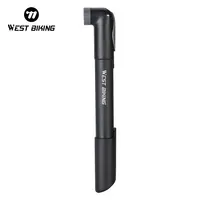
| Names a maker | 6 |
The zero in the middle is the surprising line. There is no listing here saying “Schrader only”, which is what you would expect if sellers were simply describing what they had. Either a pump does both and they say so, or they say nothing, which suggests the silence is not about the pump.
And silence does not mean it will not fit. One of the cheaper pumps here never mentions a valve in its title, and its third image shows both adapters sitting in the box. That is the whole lesson of this shelf in one listing: the titles are doing much less work than the pictures.
Nine print a pressure, three can show it to you
Here is the second finding, and it is the one that would change what I bought.
The pressure figures on this page, sorted: 80, 100, 120, 120, 120, 120, 120, 140 and 160 PSI.
Three of the twenty have a gauge. So seven pumps are selling a number that the pump itself has no way of showing you. You can pump until it feels hard, and hard is roughly where a thumb stops telling you anything, which on a road tyre is somewhere in a band forty PSI wide.
That is not the same objection this site made to car tyre inflators, where the problem was that every box claimed 150 PSI for a job that needs 35. Here the figure is not too big for the job. It is simply unreadable on the tool selling it.
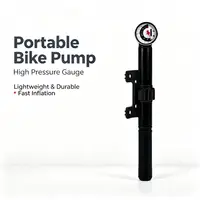
Two of the picks below have a gauge their titles never mention, one of them a rotating dial, which only turned up when the images were opened. If a gauge matters to you, do not trust the words.
The physical reason the big numbers are optimistic
One pick prints its own dimensions: a 9.7 centimetre body, 15 centimetres with the hose out. That is a small volume of air per stroke, and the higher the pressure in the tyre the less of each stroke actually goes in.
Reaching a genuine 100 PSI through a barrel that short is a few hundred strokes and a real effort at the end, with the last twenty the hardest. None of that means the number is a lie. It means it describes what the pump can do if you are determined, not what it does while you are at the side of a road in the rain.
One seller writes exactly this on its own picture: air pressure approximately 120PSI, emergency use. Approximately, and for emergencies. That is the fairest description of every pump on this page.
Two things make the effort better, and both are visible in the pictures rather than the titles. Dual action, where the pump moves air on the push and the pull, roughly halves the strokes. Length, where a telescopic barrel that extends to 40cm or more simply moves more air than a 10cm one, whatever it says on the label.
What a road tyre and a mountain tyre actually want
Thirteen of these say mountain or MTB, fourteen say road, and mostly they are the same listings saying both.
A road tyre wants somewhere around 80 to 100 PSI. A mountain bike tyre wants roughly 25 to 35. That is a factor of three, and it means a pump sold as doing both is being sold on the number that suits the harder job, while most buyers are doing the easier one.
If your bike has fat tyres, the 160 PSI on a listing is decoration. What matters is how much air moves per stroke, which is barrel size and dual action, and whether the head fits your valve.
One of the twenty is a different tool
A listing calling itself a CO2 pump and a shock pump in the same title is neither of the things on the rest of this page.
A CO2 inflator screws a small gas cartridge onto the valve and fills a tyre in seconds, then it is empty and you need another cartridge. A shock pump inflates a suspension fork or rear shock to a few hundred PSI in a very small volume, and putting one on a tyre would take all afternoon.
Both are real and useful things. Neither is a hand pump for a flat tyre, which is what you came to this page for.
Side by side
Prices in GBPUSDEUR. Each row carries the date its price was read.
| Product | Price | Why it is here | Where to buyLink |
|---|---|---|---|
| Best overall GIYO Bicycle Mini Pump 120psi Hand Air MTB Road Bike | £11.39$14.68€13.41checked 18 Oct 2026 | GIYO, one of the makers on this page, with a smart head that takes both valve types with nothing to unscrew and swap, labelled AV/FV in its own photographs, and a small pressure gauge set into the barrel, with 120 PSI given as its maximum. A frame bracket and strap come with it. Its title names both valves and mentions neither the gauge nor the smart head, and its own comparison picture sets it against a pump with no gauge, which is most of why it is here | Check opens in a new tab |
| Cheap, and better than its title A60F-Mini Bike Pump Bicycle Tire Inflator | £4.07$5.25€4.79checked 18 Oct 2026 | The title never says which valves it fits, which on this shelf would normally be a reason to walk past. Its third image shows the hose end swapping between an American nozzle and a French one, which are Schrader and Presta, and its accessories photograph adds a frame bracket, a ball needle and a balloon nozzle. 90g by its own photograph. The clearest case on the page for opening the pictures before judging a listing | Check opens in a new tab |
| Best of the ones that say what they are Mini Bike Pump Aluminum Alloy Schrader Presta Valve | £4.59$5.94€5.40checked 18 Oct 2026 | Names both valves in the title, arrives with a frame bracket, a short hose and a needle for a football, and prints its own dimensions rather than leaving you to guess: a 9.7cm body, 15cm with the hose. Aluminium alloy rather than plastic. Its own second image says air pressure approximately 120PSI, emergency use, which is the most honest sentence on this shelf and is true of everything else here too | Check opens in a new tab |
What the titles will tell you
- Ten of the twenty name both valve types, Presta and Schrader. That is the fact that decides whether a pump is any use on your bike, and where it is stated it is stated plainly. Two listings even print the two nozzle inserts side by side so you can see what you are getting.
- Nobody names only one. Not one listing of the twenty says Schrader alone or Presta alone. A seller on this shelf either tells you both fit or tells you nothing, which makes the page unusually easy to sort: ten answer the question and ten do not.
- Six name a real maker. WEST BIKING on three, GIYO on two, BETO on one, and BETO's own images carry a catalogue of eleven model numbers. On a marketplace shelf where most things are anonymous, a maker with a model range is something you can look up.
- Dual action is the feature that changes the work. A pump that inflates on the push and on the pull roughly halves the number of strokes, and on a nine centimetre barrel that matters far more than any number in the title. Few listings here say it, so look for it.
- Three name a gauge, and opening the images finds more. Two more picks below have a pressure gauge that their titles never mention, one of them a rotating dial. If a gauge matters to you, the pictures are more reliable than the words.
What to read twice
- Ten of the twenty never mention a valve at all. Which means you cannot tell from the title whether the pump fits the thin threaded valve on a road bike or the fat car style one on a hybrid. It is the first thing to check and half the shelf makes you open the listing to check it.
- Nine print a pressure and only three have a gauge. So seven of them sell a number the tool itself cannot show you. A pump claiming 120 PSI with nothing to read it by is asking you to judge a road tyre by thumb, and the difference between 60 and 100 PSI is not something a thumb can find.
- The barrels are short and the claims are long. One pick states its own dimensions as a 9.7cm body. Reaching a genuine 100 PSI through a barrel that size takes hundreds of strokes and real force at the end, whatever number is printed on the front.
- One seller says the quiet part out loud. Its own image reads air pressure approximately 120PSI, emergency use. Approximately, and for emergencies. That is the honest description of every mini pump on this page, including the ones that put the figure in bold.
- Thirteen say mountain and fourteen say road, mostly the same listings. Those two bikes want pressures that differ by a factor of three or four. A pump sold for both is not wrong, but it does mean the headline figure was chosen for the tyre you probably do not have.
- One of the twenty is not the same object. A listing calling itself a CO2 pump and a shock pump in one breath is neither of the things the rest of this page is. A CO2 inflator fires a cartridge and a shock pump inflates suspension. Both are useful, neither will get you home with a flat.