Knife sharpeners, where the grit number is the whole conversation and two titles are pull-throughs
The short answer
Prices in GBPUSDEUReach row carries the day it was read
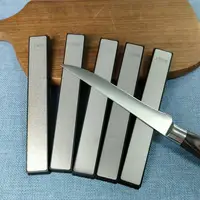


A blunt kitchen knife is slower and more dangerous than a sharp one, and the tool that fixes it costs less than the knife. Twenty of them are on this page, and the shelf splits three ways before you read a single number.
Pull-through, stone, or diamond plate
A pull-through is a handle with a slot. Draw the knife through and two angled bits of carbide or ceramic scrape a fresh edge. Two titles here are pull-throughs, one with three stages and a spare cartridge, one with a tungsten blade and a second slot for scissors. They take a minute, need no skill, and remove more metal than a stone does. The edge they leave is a sharp burr that dulls quickly, and a knife that goes through a pull-through every week is measurably shorter in a year. For a cheap knife that needs to cut tonight, they are the right tool.
A whetstone is a block of abrasive that you draw the knife across at an angle. Eleven titles here say whetstone. It is slower, it needs a steady hand, and it gives the edge that lasts, because it grinds the steel to a shape rather than scraping it. Four of the eleven say water, meaning the stone soaks before use and is used wet. One says oil, a natural green stone used with a drop of oil instead. The rest say neither, and most of them are water stones.
A diamond plate is a steel plate with diamond grit bonded on. Five titles say diamond. It cuts faster than a stone, never needs soaking, and never wears hollow, which removes two of the three things people find hard about stones. It is the right starting point for a beginner, and the four-piece set with an angle guide is the one title on this page that puts every part of a first sharpening in one box.
The grit, and what the numbers mean
Seven titles state a grit. Between them they run from 60 to 10000, and that range is the whole subject.
Below about 400 is a repair stone. It takes a chip out of an edge or reshapes a badly worn one, and it leaves scratches you can see. The 60, the two 240s and the 320 here are that.
Around 1000 is the sharpening stone. It puts a working edge on a dull knife and is the one grit that every kitchen needs. The 1000 and the 1200 here are that.
3000 and up is polish. It takes the scratches from the 1000 off and leaves an edge that slides through a tomato. 6000 is where most home cooks stop, and the natural stone here that runs to 10000 is for a person who sharpens for pleasure and owns a knife worth it.
A stone that states no grit tells you nothing. Eight titles say professional and seven state a grit, and they are not the same set.
Double-sided
Three titles are double-sided: two grits on one block, usually a sharpening grit on one face and a polish on the other. The best overall pick is one of these, and it is the only double-sided title here that says what the two sides are. The two RSCHEF stones say dual side and leave the grits to the listing.
Angle, and why the guide is the part that matters
The edge on a kitchen knife is a wedge at somewhere between 15 and 20 degrees a side. Sharpening on a stone means holding that angle across every stroke, and a wobble of five degrees rounds the edge instead of sharpening it. That is the skill, and it is the reason most people’s first stone ends up in a drawer.
Three titles here include an angle guide, a plastic clip that sits on the spine and holds the blade at the angle while you push. One of them is adjustable from 14 to 25 degrees, which covers a Japanese slicer at one end and a cleaver at the other. Two more titles say fixed angle: one is a set of diamond strips for the Ruixin RX008, a clamp system that holds the knife and swings the stone, and one is a polishing stone sold for the same kind of rig. Neither is a sharpener on its own.
Flattening, and the part of a stone’s life nobody mentions
A water stone wears. The middle goes hollow after a few months and a hollow stone sharpens a curve into the edge. Every stone owner needs a flattening stone, a coarse plate you rub the whetstone against to get it level again, and one title on this page is exactly that, at 320 grit. It is the least glamorous thing here and the one most stone owners are missing.
Scissors, and the odd one out
Three titles mention scissors. One is a pull-through with a scissors slot, one is a natural oil stone that lists scissors and a foot file among the things it polishes, and one is a garden scissors sharpener that is on this page because it says kitchen and knife on the end of the title. Kitchen scissors are better sharpened by a stone on the bevelled side only, and a pull-through with a scissors slot will do them adequately.
What none of them says
A size, on nineteen of twenty. The one that gives it says 7.1 by 2.4 by 0.6 inches, which is 180 by 60 by 15 millimetres. A stone shorter than the blade is wide makes every stroke a compromise, and a 200-millimetre stone is the small end of useful.
What the abrasive is. One title says silicon carbide, which is the hard black grit that cuts fast and wears fast. The rest say stone. Aluminium oxide, the usual answer, is never named.
Whether it comes on a base. One title says no base. A stone that slides on the worktop is a stone that cuts a hand, and a rubber foot or a wooden cradle is worth the look in the photographs.
The kitchen scale guide covers the other cheap thing in a kitchen that is sold on a word and decided by a number.
What I would actually do
For most kitchens, the double-sided water stone that states 1000, 3000 and 6000. That is a sharpening grit and a polish in one block, and it is the only double-sided title here that says what its grits are.
For a beginner, the four diamond plates with the angle guide. No soaking, no flattening, and a clip that holds the angle while the hands learn it.
For a drawer of blunt knives, the three-stage pull-through. It is not the edge that lasts, but it is the one that is ready tonight, and the spare cartridge means it stays that way.
If you already own a stone, the flattening stone. It is what makes the stone you have keep working, and no title on this page tells you that you will need it.
Whichever you buy, look for the grit, and if the title does not state one, assume the seller does not know it either.
Side by side
Prices in GBPUSDEUR. Each row carries the date its price was read.
| Product | Price | Why it is here | Where to buyLink |
|---|---|---|---|
| Best overall Whetstone Sharpening Stones Knife Sharpener Grinding | £16.16$21.56€19.01checked 18 Oct 2026 | A double-sided water stone that states its grits, 1000, 3000 and 6000, which is a sharpening grit and a polish on one block and the only double-sided title here that says what it is | Check opens in a new tab |
| For a beginner 4pcs Diamond Sharpening Stones Set Multi-Grit Knife | £7.69$10.25€9.05checked 18 Oct 2026 | Four diamond plates in different grits, with an angle guide in the box, and no soaking, no hollowing and no flattening to learn before the first edge | Check opens in a new tab |
| For a drawer of blunt knives 3-Stage Knife Sharpener with 1 More Replace Manual | £3.38$4.38€3.97checked 18 Oct 2026 | A three-stage pull-through with a spare cartridge, for the knives that need to be usable tonight rather than kept forever | Check opens in a new tab |
What a title here can settle
- The grit, on seven titles: 60, 240, 320, 1000, 1200, 3000, 6000 and on up to 10000. Below 400 repairs a chip, around 1000 puts an edge on, 3000 and up polishes it. A stone that states its grit tells you which of those jobs it does; a stone that says professional and nothing else does not.
- Diamond, on five titles. A diamond plate is steel with diamond grit bonded to it. It cuts faster than a stone, never needs soaking, never wears hollow, and works on the hard steel that a water stone struggles with. It also leaves a coarser scratch at the same grit number, which is why the polishing stones here are all natural or ceramic.
- An angle guide, on three titles, and one of them adjustable from 14 to 25 degrees. Holding an angle steady is the whole skill of sharpening on a stone, and a plastic clip that does it for you is what turns a first attempt into an edge.
- Two titles carry a maker's name, RSCHEF, on a pair of double-sided stones. A third names the Ruixin system it fits, which is a name of a different kind: a replacement part that tells you which sharpener it belongs to.
What to read twice
- A pull-through takes metal off in a straight line. Two titles here are pull-throughs, one with three stages and one with a tungsten blade for knives and scissors. They are quick and they work, and the tungsten stage scrapes rather than grinds, which leaves an edge that is sharp on Sunday and gone by Wednesday. Use one for a cheap knife you do not mind shortening.
- Water stone means soak it first. Four titles say water, one says oil, and the rest say nothing. A water stone goes in the sink for ten minutes before every use and wears hollow with every use, which is why one title on this page is a flattening stone. A diamond plate skips both.
- Professional is on eight titles and grit is on seven, and they are not the same eight. A stone that says professional and no number is asking you to guess whether it is a repair stone or a polish.
- One title states a size. A stone has to be longer than the knife blade is wide for the stroke to work, and a 200-millimetre stone is the small end of useful. Nineteen titles leave you to read the photographs.