Car USB chargers, and why the big number on the box is shared
The short answer
Prices in GBPUSDEUReach row carries the day it was read

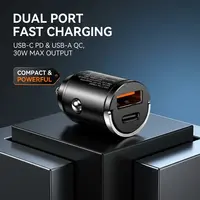
A car charger is a plug for the round 12V socket with a USB port or two on the end. It is a two pound object that every listing sells with a wattage that belongs to a laptop power supply. The number is not a lie, exactly. It is a sum, and the sum is not what your phone gets.
The socket sets the ceiling
Behind every 12V socket is a fuse. In most cars it is 10 or 15 amps. Volts times amps is watts, and 15 amps at 12 volts is 180 watts, less in practice because nothing is perfectly efficient. A 10 amp fuse gives about 120.
That is the ceiling for everything plugged into that socket, whatever the plug claims. A charger titled 250W or 326W is adding up what its ports could each do if the car could feed them, and the car cannot. Pull that much and the fuse goes, and then the socket is dead until you find the fuse box.
Read any headline over about 150W as a description of the ports, not of the charging you will get. Five titles here are over 200W.
The headline is shared
Most of these chargers have two or more ports. The wattage in the title is almost always what the charger can do in total, and often what one port can do when it is the only one in use. Plug in a second device and the ports divide the power between them, in a split the listing usually does not state.
Four titles here state it. “PD 45W USB C and 30W USB A” means the USB-C port gives 45 watts and the USB-A port gives 30, and you can plan around that. “90W, dual 30W PD and 30W USB A” means three ports at 30 each. Those are the honest titles, and two of them are the picks on this page for that reason.
A title that says only “100W dual port” has told you the sum. Assume the ports share it and you will not be disappointed.
What your phone actually takes
A phone charges at somewhere between 20 and 45 watts at its fastest, and most of them are nearer 20 than 45. From a 30W USB-C port, almost any phone charges at full speed. A tablet takes a little more. A laptop wants 65 watts or more from a single port, and that is the only reason to care about the bigger numbers.
So for a phone, the question is not “how many watts” but “does the USB-C port do PD at 20 watts or more”. Fifteen of the sixteen titles here say PD. The one that leads with 3.1A instead is the older 5 volt kind, about fifteen watts shared across both ports, and it is the one to skip.
PD and QC, the two letters that matter
PD is USB Power Delivery, the standard that USB-C phones, tablets and laptops all negotiate charging speed with. It is the one to have.
QC3.0 is Qualcomm Quick Charge, the older standard on USB-A ports, used by many Android phones and by nothing made by Apple. A USB-A port with QC3.0 is a fine second port for an older cable.
A charger with one PD port and one QC port covers everything you are likely to plug in. Several here are exactly that.
SuperVOOC, and any other charge protocol named after a phone brand, only reaches its full speed on that brand’s phones. On everything else it falls back to ordinary speed. One title here is a SuperVOOC charger. Buy it if you have that phone, and not otherwise.
12 volts or 24
Cars run 12 volt sockets. Vans and lorries often run 24. A charger titled 12-24V works in both, and only two of these say so. If you drive a van, check the title for that before the wattage.
Flush, mini, and the plug that sticks out
A standard charger sticks a few centimetres out of the socket, which in some cars is exactly where a knee goes. The mini and flush-fit ones sit level with the socket. That is genuinely useful, and the trade is real: less room for ports, less room to shed heat, and usually a title that gives one number and no split.
The flush-fit pick on this page is the example. Its title says 100W. Its own photographs say 30W maximum output. That is the whole gap between a headline and a port, in one listing, and it is still a good charger for a phone, because a phone wants about 30W.
A charger that gets hot under a heavy load is not broken. It is a small object doing a lot, and the flush ones do it with less air around them.
What I would actually do
For one phone and a passenger’s, the charger that states 45W on USB-C and 30W on USB-A. Both ports do their stated job at the same time, and either is more than a phone needs.
For a family, the three-port one that states 30W on each. Three phones, all at full speed, and the total stays under what a socket can give.
For a car where the socket is by your knee, the flush-fit mini. Two ports, nothing sticking out, and treat its headline as a sum.
And whichever you buy, ignore anything over 150 watts in a title. The car will.
Side by side
Prices in GBPUSDEUR. Each row carries the date its price was read.
| Product | Price | Why it is here | Where to buyLink |
|---|---|---|---|
| Best overall 75W Dual Port Car Charger PD 45W USB C and 30W | £4.10$5.47€4.82checked 18 Oct 2026 | States the split, 45W on USB-C and 30W on USB-A, which is the number a phone actually sees | Check opens in a new tab |
| If you charge three things 90W Type C Car Charger Adapter 3 Ports Dual 30W PD | £5.85$7.79€6.87checked 18 Oct 2026 | Three ports and the title says what each does: two 30W USB-C and one 30W USB-A | Check opens in a new tab |
| If you want it to disappear Flush Fit Mini Car Charger 100W Dual Port Type C PD | £4.96$6.61€5.83checked 18 Oct 2026 | Flush fit, so it sits level with the socket, two ports, and a headline the title does not split | Check opens in a new tab |
Read the split, not the total
- A title that says 45W USB C and 30W USB A is telling you what each socket does on its own. That is the number your phone sees, and the titles that state it are the ones to trust.
- PD on a USB-C port is the standard every modern phone, tablet and laptop charges by. QC3.0 on a USB-A port is the older Android one. A charger with one of each covers everything you own.
- 12-24V in a title means it also works in a van or a lorry, whose sockets run at 24 volts. Only two titles here say it; if you drive a van, look for it before anything else.
- A flush-fit or mini charger sits level with the socket, so nothing sticks out to catch a knee. The trade is fewer ports and usually no split stated.
What 250W does not mean
- A 12V socket cannot deliver 250W. Behind it is a fuse, usually 10 or 15 amps, and 15 amps at 12 volts is about 180 watts. Anything a title claims above that is arithmetic across ports that the car will never supply at once.
- The headline is the sum, on a good day. A 100W charger with two ports often gives 100W to one port alone and much less to each when both are used. If the title does not say the split, assume the ports share.
- Your phone takes 20 to 45W. Almost every phone charges at its full speed from a 30W port. The extra wattage is for laptops, or for nothing.
- SuperVOOC, and any other brand-named fast charge, only reaches full speed on that brand's phone. On anything else it charges at ordinary speed.