GaN wall chargers, where ten never say which plug and none names a safety mark
The short answer
Prices in GBPUSDEUReach row carries the day it was read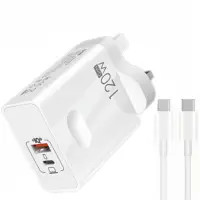

Twenty GaN USB-C wall chargers, and the first thing to say is about my own search. Every one of the twenty says GaN, because that is what I asked the gateway for. A page that presented twenty out of twenty as a finding would be describing its own query. GaN is real, gallium nitride runs cooler and smaller than the older silicon parts at the same output, but on a shelf where every listing says it, it separates nothing.
The cheap phone extras guide could set the charger question aside with one line: nothing on it plugged into the mains. This page is that question. A wall charger is the one phone accessory that sits in a socket overnight, and the two things a UK buyer most needs to know about it are the two things these titles say least about.
Which plug is in the box
Ten of the twenty titles never state a plug region at all.
Of the ten that do, nine say EU, eight say US, three say UK, and one is sold for the UK and nowhere else. On a cable or a case this would be trivia. On a charger the plug is the product: a two-pin plug moulded onto the body means an adapter under it every time it is used, and a lightweight travel adapter carrying a 65W brick out of a wall socket is not an arrangement anyone should live with.
So the first act on every listing here is to open the variant list and find the UK option. Three titles say it is there. For the other seventeen the title does not know, and the picks below are the ones where it does.
What 240W means, and what it does not
| Claimed | Titles |
|---|---|
| 33W, 45W, 55W | 3 |
| 65W | 7 |
| 120W | 6 |
| 240W | 4 |
240W is the top of the USB Power Delivery 3.1 standard. It is 48 volts at 5 amps, delivered on one port, into a laptop that asks for it, through a cable built and marked for it. No phone made asks for it and no phone cable on the cable guide could carry it. A charger with five ports and 240W on the title is describing a total across the ports at best. A charger with two ports and 240W on the title is describing a number.
120W is a different kind of claim. It is Xiaomi’s own fast-charging figure, reached over Xiaomi’s own handshake with Xiaomi’s own phones, and it is real in that one pairing. Plug anything else into a 120W charger and it delivers whatever its PD figure is, which is the number that matters and the number none of the six 120W titles states.
65W, on seven titles, is the figure that makes sense. It charges any phone at the fastest rate the phone will accept and runs a USB-C laptop at a working pace, and it is what the rest of this page is measured against.
Ports, and the split nobody prints
Ten titles state a port count: six say two, three say four or five, one says eight. Not one says how the watts divide when more than one port is in use.
That is the number a buyer actually needs. A 65W charger with two ports is usually 65W to one port on its own, and something like 45W and 20W once the second cable goes in. That is fine and it is normal. But a title that says 65W and two ports, and stops there, is promising 65W to each of them by saying nothing, and the promise is one it cannot keep.
PD, PPS, and which phone you own
Fourteen titles say PD, which is the open standard nearly every current phone charges over, and where a title says it the headline number at least belongs to a system your phone can negotiate with. Seven also say Quick Charge, the older Qualcomm scheme, which does no harm.
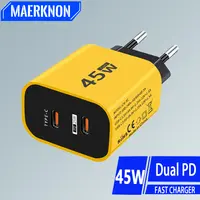
One title says PPS. PPS is the extension to PD that a Samsung needs in order to reach its own Super Fast figures; without it a Galaxy takes a slower, ordinary PD rate from a charger whatever its wattage. So the single PPS listing here is the only one on the page that is a true answer for a Samsung, and it is a 33W one, which is Samsung’s 25W tier rather than its 45W tier. The 45W dual-port charger further down does not say PPS, and so for a Galaxy it is a 25W charger with a bigger number on it.
Not one title names a safety mark
No CE. No UKCA. No BS 1363. No mention of a fuse.
This page cannot say that any of these chargers lacks a mark, and does not. It can say that on twenty listings for a device that will sit in a wall socket while the house sleeps, not one seller thought the mark worth a word of the title. A UK plug carries a fuse by design, which is one more reason to want the UK plug and not an adapter. Look for the marks moulded into the casing in the listing photographs before paying, and if they are not in the photographs, buy something whose are.
One listing, two names
Titles 1 and 19 on this shelf are the same text word for word, 120W, two ports, US/EU plug, and one of them wears the Lenovo name at the front while the other says “New”. Lenovo does make chargers. A marketplace listing that shares its every word with an unbranded one is a name and not a maker, and it is not picked.
What I would buy
The one sold for the UK alone, because on a mains charger the plug is the first thing to settle, and read its 120W as Xiaomi’s number: for any other phone it is a 65W-class charger.
If it is going in a bag, the 55W that offers EU, US, UK and AU plugs in one listing, and treat it as a two-device charger rather than a laptop one.
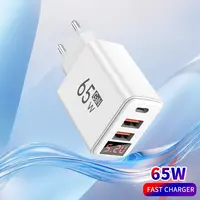
If the numbers on this page have made you suspicious, the one with the display, because it is the only charger here whose claim you can check.
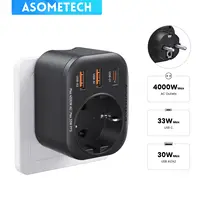
If you own a Samsung, the one that says PPS, and accept 33W, because it is the only listing on the page that names the thing a Galaxy needs.
I have not handled any of these. The titles are the whole of the evidence, and every price in the table carries the date I read it.
Side by side
Prices in GBPUSDEUR. Each row carries the date its price was read.
| Product | Price | Why it is here | Where to buyLink |
|---|---|---|---|
| Best overall, sold for the UK and nowhere else 120W GaN USB Fast Charger UK Plug Power 5.0 QC5.0 | £6.75$9.01€7.94checked 18 Oct 2026 | The one title of twenty where UK is the only plug region named, so the listing is built for a buyer here rather than offering this country as an afterthought in a variant list. Read the 120W as Xiaomi's figure: for any other phone this is a 65W-class charger, and the title does not state the PD number, so it is the plug that earns it a place, not the headline | Check opens in a new tab |
| The one that shows you the number 65W Digital Display USB Charger GaN PD Fast Charging | £4.58$6.06€5.39checked 18 Oct 2026 | A 65W charger with a digital readout of the watts going out. Nothing else here lets a buyer check the claim: plug a phone in and the display says what it is drawing, which will be a good deal less than 65 and will tell you more about the phone than the charger. Buy this if the numbers on this page have made you suspicious, which they should have | Check opens in a new tab |
| The only one that says PPS 33W GaN Charger 4-IN-1 4000W AC Outlets Power Strip | £13.98$18.02€16.45checked 18 Oct 2026 | 33W, PD and PPS named, with mains sockets built in, so it is a small power strip that charges as well. PPS is what a Samsung needs to reach its own Super Fast figure, and this is the only listing here that says the word. At 33W it is Samsung's 25W tier rather than the 45W one, and it is the only honest answer on this page for a Galaxy | Check opens in a new tab |
What a title here can settle
- Which plug, on ten of the twenty. Three offer a UK plug, and one is sold for the UK and nowhere else. This is the first thing to settle and on a mains charger it is the whole product: a charger with a two-pin plug moulded on is a charger plus an adapter, every time it is used, and a lightweight travel adapter under a 65W brick is not a pairing to live with. Buy the UK variant or buy elsewhere.
- A sensible wattage, on ten. Seven say 65W and three say 33W, 45W or 55W. 65W is the figure that charges any phone at full speed and a USB-C laptop at a working pace, and it is the number the rest of this page is measured against.
- PD, on fourteen. USB Power Delivery is the open standard that every current iPhone, Pixel and most Android phones negotiate over. Where a title says PD, the headline number at least belongs to a system your phone can talk to. Seven also say Quick Charge, which is the older Qualcomm scheme and does no harm.
- One title says PPS, and one has a display. PPS is the addition to PD that a Samsung needs to reach its Super Fast figures, and exactly one listing here names it. The display is the more interesting feature: a charger that shows the watts actually flowing is the only one on the page whose claim you can check at the kitchen table.
What to read twice
- Every one of these says GaN because that is what I searched for. Twenty out of twenty is my query reflected back and proves nothing about the shelf. GaN is a real thing, gallium nitride lets a charger run smaller and cooler at the same output, but it is a material and not a promise, and on this page it separates nothing from nothing.
- Four claim 240W and six claim 120W. 240W is the top of the USB PD 3.1 standard: 48 volts at 5 amps, on one port, into a laptop that asks for it, through a cable rated for it. No phone made asks for it. A 240W charger with five ports is a total across the ports at best, and a 240W charger with two is a number. 120W is Xiaomi's own fast-charging figure, reached over its own handshake with its own phones; for any other phone a 120W charger delivers whatever its PD figure is, which the title does not state.
- Not one title says how the watts split between ports. Ten state a port count and none says what happens when two things are plugged in. A 65W dual-port charger typically becomes 45W and 20W the moment the second cable goes in, which is fine, and it is the number a buyer should be told. A title that says 65W and two ports is promising 65W to each of them by silence.
- Not one title names a safety mark. No CE, no UKCA, no BS 1363, no mention of a fuse. This page cannot say that any of these lacks one; it can say that on twenty listings for a device that sits in a wall socket overnight, nobody thought the mark worth a word. A UK plug carries a fuse by design. Look for the marks in the photographs of the casing before you buy, and if they are not there, do not.