Head torches, seven give a lumen number and none gives an hour
The short answer
Prices in GBPUSDEUReach row carries the day it was read


Twenty rechargeable head torches, all of them with a motion sensor so you can turn them on by waving a hand at them. I went looking for the sensor on purpose, so that feature is on every one here by selection rather than by coincidence. Everything else below is what the shelf came back with.
Seven of the twenty tell you how bright they are. None of the twenty tells you for how long.
The number that matters is on none of them
Lumens describe a moment. A head torch that claims 1,000 lumens is claiming what it does the instant you switch it to maximum, not what it does an hour into a walk, and almost every torch of this kind steps down within minutes because the alternative is cooking its own LED. So the useful figure is the pair: this many lumens, for this many hours.
Not one of these twenty titles gives the second half. No hours, no minutes, no “up to” anything. On a product bought specifically so you can see for a while in the dark, the whole shelf declines to say how long the seeing lasts in the one place a search can read.
It is sometimes in the pictures. While choosing photographs for this page I opened the first image of each listing, and the BORUiT B33 prints 210 lumens, IPX4 and two to five hours across the top of its own product shot. None of that is in its title. So the lesson here is practical rather than cynical: scroll the images before you buy. On this shelf the specification is more likely to be in a picture than in the words, and a seller who puts the hours next to the lumens has told you something the other nineteen have not.
That is not a reason to buy nothing. It is a reason to treat every brightness figure on this page as a ceiling that is touched briefly, and to assume the setting you will actually live on is a much lower one. Which is also why 300 lumens from a maker who says 300 is a better buy than a five-figure number from one who says nothing.
Two of the seven numbers are not possible
The seven figures on this page are 300, 450, 800, 1,000, 1,000, 120,000 and 800,000 lumens.
For scale: a car’s dipped headlight is around 1,000 lumens, and a 100 watt bulb of the old kind was about 1,600.
A cheap LED converts electricity to light at roughly 100 lumens per watt if it is doing well. At that rate 800,000 lumens needs about eight kilowatts, which is more than twice what a kettle draws. A head torch battery holds somewhere near ten watt-hours. Eight kilowatts out of ten watt-hours lasts about four seconds, and then you are standing in a field in the dark holding a warm object. The 120,000 lumen claim is the same arithmetic with a smaller silly number: well under a minute.
So these are not exaggerations of the usual affiliate sort, where a claim is optimistic but pointed at something real. They are off by a factor of hundreds.
The prices give it away
Here is the part that needs no physics at all. These are the seven listings that give a number, sorted by what they cost on the day this was written.
| Price | Claimed | Name on the listing |
|---|---|---|
| 7.78 | 450 lumens | BR03 |
| 9.17 | 300 lumens | BORUiT |
| 9.29 | 1,000 lumens | BORUiT |
| 9.54 | 800,000 lumens | none |
| 10.17 | 1,000 lumens | BORUiT |
| 13.62 | 800 lumens | BORUiT |
| 19.30 | 120,000 lumens | none |
The 800,000 lumen listing sits between the two that claim 1,000. Dearer than one of them, cheaper than the other, inside a band of about a pound. Eight hundred times the light, for the same money, from the listing with nobody’s name on it.
If the number meant anything it would be the most expensive thing here by an enormous margin. It is fourth of seven. That is the whole argument, it is visible in the prices above, and it does not depend on trusting me.
The 120,000 lumen listing is the dearest of the twenty, which tells you what the number is doing: it is priced as a premium product on the strength of a figure that nothing in the product supports.
Who put their name on it
Nine of the twenty carry a maker’s name or a model code. Five of those are BORUiT, which sells a catalogue of lights under its own name, and there is also SMILING SHARK with a model number, a BR03, and the XTE glasses clip.
Now line the names up against the numbers. Every brightness figure from a listing with a name on it is between 300 and 1,000 lumens. Both figures from listings with no name are above 100,000.
That is not a coincidence and it is not really about honesty either. It is about consequence. A seller with a catalogue and a name has something to lose if its 1,000 lumen torch is obviously a 400 lumen torch. An anonymous listing has nothing to lose, so the number is free, so it is enormous.
What you wear it on
Seventeen of these are the ordinary elastic headband. Two clip to the peak of a baseball cap, and one clips to the arm of your glasses.
This is worth deciding before you buy rather than after. A headband over a bare head is fine. A headband over a hat is awkward. A headband with glasses underneath pushes the arms into the sides of your head, which is tolerable for ten minutes and not for an evening. If you wear glasses whenever you are outdoors, the clip is not a gimmick, it is the version that fits you.
The cap clips are lighter than everything else here and put nothing round your head at all, with the obvious catch that they need a cap.
The battery is what ends it
Three of the twenty name the cell they take: two 18650 and one 14500. Both are standard sizes sold everywhere. When the cell tires, you buy another one and the torch carries on.
The rest either say “built-in battery” or say nothing, which in practice means the same thing. A built-in lithium cell in a cheap torch loses a noticeable share of its capacity each year, and when it is done the torch is done, because nothing here is designed to be opened.
For a torch that lives in a drawer and comes out twice a winter, that is fine, and the built-in ones are simpler. For one you will use every dark evening from October, the replaceable cell is the difference between a torch that lasts and a torch that gets thrown away.
If you only take one thing from this page
Buy the modest number from the seller who signed it, not the enormous number from the one who did not. On this shelf those come out at roughly the same price, and one of them is telling you something.
Side by side
Prices in GBPUSDEUR. Each row carries the date its price was read.
| Product | Price | Why it is here | Where to buyLink |
|---|---|---|---|
| Best overall BORUiT 020 Motion Sensor Headlamp 1000LM 18650 | £10.45$13.94€12.31checked 18 Oct 2026 | The only pick where every claim in the title is one you can check: BORUiT puts its own name and a model number on it, the brightness it quotes is a figure a head torch can actually make, and it takes an 18650 cell you can replace when the first one dies. One caveat found while choosing its photograph, and it is the sort of thing this page exists for: the title says Type-C but the cable in the listing's own first image is the older micro USB shape. If the socket decides it for you, look at that image before you buy | Check opens in a new tab |
| The same maker and the same figure, for a little less BORUiT RJ-020 LED Induction Headlamp 1000LM Motion | £9.78$13.04€11.51checked 18 Oct 2026 | The same maker and the same brightness figure as the pick above, a little cheaper, and it takes the same replaceable 18650. The one thing it does not say is what it charges over, where the pick above says Type-C in as many words. If that matters to you, pay the difference; if you have a drawer of assorted cables, this is the better buy of the two | Check opens in a new tab |
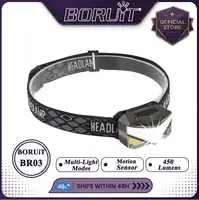
| A modest number at the cheap end BR03 450LM Motion Sensor Dual Light LED Headlamp | £10.13$13.12€11.92checked 18 Oct 2026 | Names a brightness a head torch genuinely delivers, says waterproof, and has two light sources, all at the lower end of this page. Its title gives only a model code, but its own first image shows the BORUiT name, so this is the same maker as the two picks above with the name left out of the one place a search can read it. Cheapest of the named ones here | Check opens in a new tab |
What a title here can settle
- What it attaches to, on all twenty. Seventeen are the ordinary elastic headband. Two clip to the peak of a cap, which is lighter and has nothing round your head, and one clips to the arm of a pair of glasses. If you wear glasses or a cap anyway, that choice is worth making on purpose rather than discovering afterwards that a headband and spectacle arms fight each other.
- Whether the battery comes out, on three. Three name the cell they take: two say 18650 and one says 14500. Both are standard sizes you can buy anywhere. Everything else here either says the battery is built in or says nothing, and a built-in cell is the part that ends the torch's life, usually in two or three winters.
- A red mode, on three. Red light does not wreck your night vision the way white does, and it does not carry across a field or wake somebody in a tent. On a torch meant for fishing, walking a dog at dusk or moving about a campsite, it is a genuinely useful second mode and it is easy to check for.
- A sane brightness, on five. The five listings that give a number and also carry a maker's name say 300, 450, 800, 1,000 and 1,000 lumens. That whole range is what a real head torch delivers, and 300 is plenty for a footpath. These are the numbers on this page that behave like measurements.
What to read twice
- Not one of the twenty titles says how long it runs. No hours, no minutes, nothing. Brightness without a time attached is half a specification, because the same torch might give you its headline number for forty minutes or its lowest setting for twenty hours, and those are different products. One listing does print the hours across its own product photograph, which is the practical lesson on this shelf: scroll the images, because the specification is more likely to be in a picture than in the words.
- Two claim brightness that is not physically available. One says 120,000 lumens and one says 800,000. A car's dipped headlight is around 1,000. Even at the best efficiency a cheap LED manages, 800,000 lumens needs several kilowatts, and a head torch battery holds roughly ten watt-hours, so it would run for a few seconds before going flat. Neither of those two listings carries a maker's name. Both figures are decoration.
- The 800,000 lumen one is priced like a 1,000 lumen one. Two listings here claim 1,000 lumens, and the one claiming 800,000 sits between them on price, inside a band of about a pound. Eight hundred times the light for the same money. The article below sets the seven numbered listings out in a table so you can see it rather than take my word for it.
- Six say waterproof and one gives a rating. Only the glasses clip states IPX4, which is a defined test meaning splashes from any direction. The other six use the word with no number behind it, so there is no way to tell a torch that survives a downpour from one that does not like drizzle. On something worn outdoors in Britain this is the claim that most needs a number and least often has one.
- Two pairs of near-identical listings at very different prices. Two titles are word for word the same but for a capital letter and one word, and the dearer is most of the way to double the cheaper. Two more are the same BORUiT B33, one charging over USB and one over Type-C, and the Type-C one is the cheaper of them. Read the whole page before buying anything on it.