LED strip lights, and the number that decides it is where you can cut
The short answer
Prices in GBPUSDEUReach row carries the day it was read

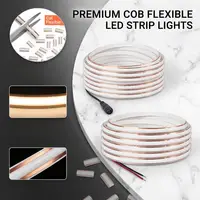


Twenty self adhesive LED strips, taken from one search and none of them handled here. They are sold for the back of a television, the underside of a kitchen cupboard, a stair, a wardrobe, a shelf.
Everybody cuts these to length. Not one of the twenty titles says where you are allowed to cut.
The measurement your room imposes, and the shelf declines to state
A strip is bought to fit something: the width of a worktop, the back of a screen, the length of a shelf. So the first practical question is not how bright it is. It is whether you can make it the length you need.
You cannot cut a strip anywhere you like. The copper track runs in repeating segments and there is one marked point per segment where the circuit can be broken without killing everything after it. Cut between the marks and the section goes dark.
That interval is the number that decides whether the strip fits your shelf, and here is what this page does with it.
| Where the interval appears | Count |
|---|---|
| In the title | 0 of 20 |
| The word “cuttable” in the title, with no interval | 2 |
| Printed in one of the listing’s own photographs | most of them |
And the intervals genuinely differ. Opening the images on the picks below found three answers on one page of results:
- Cut anywhere. The cheapest strip here says so in a specification table in its own first photograph, and calls it an arbitrary cut.
- Every 2.5cm. Two of the 5V COB strips print exactly that, one as a measurement and one as a row of little scissors along the board.
- Every 10cm. The mains strip, which is four times coarser than the rest.
Ten centimetres is enough to matter. If your shelf is 87cm, a strip you can only cut every 10cm gives you 80cm and a gap, or 90cm and a fold.
Four different voltages, sold in one list
The other thing this page mixes without saying so is how the strip is powered. Fifteen of the twenty state a voltage and they are not variations on a theme, they are four different products.
| What it runs on | How many | What that means for you |
|---|---|---|
| 5V | 10 | A USB socket, a phone plug, a power bank. Nothing else to buy |
| 12V | 1 | Needs a mains driver, sold separately |
| 24V | 2 | Needs a mains driver, sold separately. Better over long runs |
| AC 220V | 2 | Plugs into the wall. A different animal, see below |
| Battery | 3 | Nothing to plug in, and something to recharge |
If you have not thought about this, 5V is the one that works when it arrives. A 12V or 24V strip without a driver is a reel of tape.
The 220V ones deserve their own sentence. They are in the same list, at about the same price, and they carry mains voltage along their whole length. That is not a reason to be frightened of them, it is a reason not to buy one by accident for the back of a telly. They cut only at the coarse interval above, the cut end needs sealing properly rather than tucking behind a cupboard, and the sensible use is a long outdoor or garage run where their advantage, no driver and no voltage drop, is the point.
COB or SMD, which is the difference you will see
Eleven say COB, four say SMD, and five say neither.
SMD is individual chips spaced along the board, usually labelled 2835 or 5050. Look at it directly and you see a row of dots.
COB is a continuous strip of phosphor over the chips, so it reads as a line of light rather than a row of points.
At two metres up a wall, behind a television, nobody can tell. Under a cupboard at eye level, or anywhere you can see the strip itself rather than only what it lights, COB is the one that looks like a light fitting and SMD is the one that looks like a strip of components.
One seller makes this argument better than I can. The ten metre reel below has, in its own gallery, a photograph of COB beside SMD with the caption that one is uniform and the other has dark spots. It is selling you the COB, and it is also simply true.
The two numbers almost nobody gives
Six of twenty give a density, in LEDs per metre, and the figures run from 120 to 576. Density is what decides whether dots show: more chips, closer together, less gap. On a COB strip anything from about 300 upward is a smooth line. The 120 per metre figure belongs to one of the mains strips.
Two of twenty give a lumens per metre figure and a colour rendering index, and they are the same two, and on the day this was written they were the two dearest things on the page.
Lumens per metre is how much light. Colour rendering index is how honest that light is about colour: low CRI makes food, skin and wood look grey and slightly wrong, which is exactly the effect people are trying to avoid when they put a nice light under a kitchen cupboard. Above 90 is good.
That those two figures appear together, on the two most expensive listings, and nowhere else, is the most useful pattern on this page. Paying roughly three times the cheapest price on this shelf buys you a seller willing to tell you what you are getting.
One strip does not say its voltage anywhere in its title
The best specified listing here, the 1000 lumen CRI 90 one, never states its voltage in the words.
It is 12V. The only place that appears is printed along the circuit board in one of its own product photographs, where the little +12V markings repeat down the strip.
That is the second time in two days that opening the images on this site has found the deciding fact sitting in a picture while the title stayed quiet about it. It is picked below, because it is a good strip, with the voltage named here instead.
Side by side
Prices in GBPUSDEUR. Each row carries the date its price was read.
| Product | Price | Why it is here | Where to buyLink |
|---|---|---|---|
| Best overall 1000LM/M COB LED Strip Light 5 Meters Self Adhesive | £8.54$11.05€10.04checked 18 Oct 2026 | The only kind of listing on this shelf that tells you both halves: 1000 lumens per metre for how bright, and a colour rendering index above 90 for whether the light is pleasant to be under. COB, so a continuous line with no dots, and five metres on a reel. One catch worth knowing before you order: the title never says its voltage, and the photographs of the strip itself have 12V printed along the board, so you will need a 12V driver to run it | Check opens in a new tab |
| Best cheap one that works out of the envelope DC 5V Waterproof COB LED Strip 320LEDs/m Self | £2.71$3.51€3.19checked 18 Oct 2026 | 5V, so it runs from a USB socket, a plug adaptor or a power bank with nothing else to buy. COB at 320 LEDs per metre, which is dense enough that you see a line rather than dots. Its own images give it an IP67 rating and mark the cutting size at 2.5cm, which is the pair of facts this whole shelf usually withholds. This is the one to buy if you want light under a cupboard tonight | Check opens in a new tab |
| Cheapest, and the most honest listing here Super Bright DC24V COB LED Strip 192LEDs/m Flexible | £0.93$1.20€1.10checked 18 Oct 2026 | The cheapest thing on this page by a distance, and its own photograph carries a specification table naming the board width, the density, the voltage, the watts per metre and the cutting unit, which it gives as arbitrary. Cut anywhere is genuinely useful when you are fitting to an awkward length. It is 24V, so it needs a driver, and that is the reason to treat the price as the price of the strip rather than the price of the job | Check opens in a new tab |
What you can settle from the listings
- Eleven of the twenty say COB and four say SMD, which is the difference you will actually see. COB is a continuous line of light. SMD is a row of separate dots that show through a diffuser at close range. One seller puts the two side by side in its own gallery and the difference is obvious in the photograph.
- Fifteen of twenty state a voltage, and it is the first thing to check. 5V runs off a USB socket or a power bank. 12V and 24V need a driver you are usually not sent. A strip is not a thing you can plug in until you know which of those it is.
- Where you may cut it is printed in the pictures on most of them. One says cut anywhere, several mark the scissors every 2.5cm, and the mains one says every 10cm. Open the images and look for the little scissors symbol before you measure your shelf.
- Two listings give a lumens per metre figure and a colour rendering index. 1000 lumens per metre with CRI above 90 tells you both how bright it is and whether it will make your kitchen look like a car park. Those two are the dearest on the page and they are the only two that say.
- The cheapest thing here comes with a full specification table in its own photograph. PCB width, LEDs per metre, voltage, watts per metre and the cutting unit, all five, on the least expensive strip here. It is the most informative listing on the shelf and the cheapest, which is not the usual order.
What to read twice
- Not one of the twenty titles says where you can cut it. Cutting to length is the thing everybody does with a strip, it is the one measurement your shelf or your TV imposes, and the number is in none of the words you search by. Two titles say the word cuttable and stop there.
- Two of these plug straight into a wall socket at 220 volts. They sit in the same search results as a 5V strip that runs off a USB port, and nothing in the ordering of the page separates them. A mains strip can only be cut at the marked 10cm points, the cut end has to be sealed properly, and it is not the thing to stick under a kitchen cupboard on a whim.
- A 12V or 24V strip is not a complete product. It needs a mains driver of the right wattage, and the listings sell the strip. If you have not bought a driver, a 5V USB strip is the one that works out of the envelope.
- One listing never states its voltage in the title at all. It is 12V, and the only place that appears is printed on the circuit board in one of its own photographs. It is also one of the best strips here, which is the annoying part.
- Only six of twenty give a density, and density is what decides whether you see dots. The figures here run from 120 to 576 LEDs per metre. Below roughly 300 on a COB strip, or on any SMD strip, you will see the individual points of light if the strip is anywhere near eye level.
- Only five say waterproof and only two give an IP number. Waterproof is a word. IP65, IP67 and IP68 are different amounts of water, and a strip going anywhere near a bathroom or outdoors wants the number rather than the word.