UV torches, seven say 365, seven say 395, and five never say at all
The short answer
Prices in GBPUSDEUReach row carries the day it was read


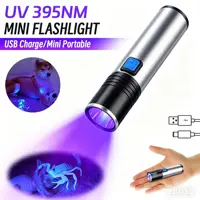


Twenty ultraviolet torches, the kind sold for finding pet stains, checking a banknote, hunting scorpions or making things glow at a party. Every one of them was taken from a single search and none has been handled here.
This shelf breaks the pattern of every other one on this site. Usually the number that decides the purchase is the number no seller prints. Here fifteen of the twenty print it, and the interesting part is what the other five do, and what happens on the one listing that prints both.
The whole decision is two numbers, and they are closer than they look
| What the twenty titles say | How many |
|---|---|
| 365nm | 7 |
| 395nm, one of them written as a 395 to 400 range | 7 |
| Both 365nm and 395nm | 1 |
| No wavelength at all | 5 |
Both numbers are ultraviolet. The difference is not how much UV comes out, it is how much visible light comes out alongside it.
An eye stops seeing at somewhere around 400 nanometres, and it stops gradually rather than suddenly. A 395nm LED is sitting right on that edge, so a good deal of what it emits is violet light you can see perfectly well. The beam looks bright and purple, and that purple lands on the carpet, the wall and the stain together.
A 365nm LED sits further out. Much less visible light escapes, so the beam looks weak, almost disappointing, and the thing you are hunting glows against something closer to darkness.
So you are not choosing brightness. You are choosing contrast, and the lamp that looks better in the shop is the one that shows you less.
That is also why 365nm costs more. The emitter is harder to make and less efficient, so at the same price a 365nm torch is smaller, dimmer or both.
The sellers make this argument better than I can
This is the part I did not expect. While opening the images to choose photographs for the pins, two listings turned out to be explaining the wavelength question themselves.
One prints the same rocks photographed three times: under ordinary light, under 395nm, and under 365nm. The 365nm frame is the one where the minerals light up and the background does not. It is the clearest demonstration of the whole argument on the page and it is sitting in a seller’s gallery.
The other is the listing whose title says 365/395nm. Its fifth image is a panel headed “Difference between 365nm UV and 395nm UV”, and its own text says that 365nm is hard to see and that 395nm is, in its words, especially cost effective. A seller telling you the cheaper option is chosen for being cheap is more useful than most of what is written above it.
A filter is what the dearer lamps are really selling. Two listings show a dark, almost black lens and explain that it filters out the leftover visible light so the purple is purer. One puts a number on it and claims 99 per cent of stray light removed. That is the contrast argument again, in glass, and it is why a good 365nm torch looks dim and finds more.
One LED cannot be two wavelengths
An LED emits a narrow band around one wavelength. It cannot be 365nm and 395nm at the same time, so a title saying both is not describing a product, it is describing a menu.
Sometimes that is harmless, as above, where the listing explains the options and you simply pick. But the price you see belongs to one of those options, and on a shelf where 365nm costs more to make, it is not hard to guess which.
The same habit shows up in the buyers’ list this site is built from. Of its seven ultraviolet torches, three give both numbers. So this is how the category is sold, not a quirk of one search.
One listing says 365nm in words and 395nm in its own photograph
Worth a section on its own, because it took about four seconds to find once the images were open.
A torch whose title begins “USB Rechargeable 365nm UV Flashlight” has, as its first image, a row of specification icons. The first icon reads 395nm.
Nothing about that is subtle. The title and the picture disagree about the one property that decides whether the thing is worth buying, and only the title is searchable. It is not picked below, and it is the single best argument on this page for scrolling through every image before you spend anything.
Three wattage claims, and a pattern that does not repeat
Three titles give a wattage: 120W, 90W with a 30W white laser beside it, and 60W.
A torch of this size runs on one 18650 cell, which holds somewhere around ten to twelve watt hours. A genuine 120 watt draw empties that in about five minutes, and a 120 watt LED needs a heatsink bigger than the torch it is in. What these numbers usually describe is the sum of what the LEDs are rated at, which is not the same thing at all. The 60W listing is refreshingly clear about it: its own first image reads 6X365NM, so the sixty is six emitters.
The pattern named on this site yesterday does not hold here, and that is worth saying. On the head torch shelf the impossible numbers sat on the cheapest listings with nobody’s name on them. Here the wattage claims are on the dearest things on the page, both of them several times the price of the ordinary torches around them. A pattern that fails to repeat is still information: on this shelf a big number is a sign of a bigger lamp, not of a bolder lie.
What does repeat is the variant trap. The 120W listing shows 60W, 80W and 120W across the bottom of its own first picture, so the wattage is a choice you make at the checkout, not a fact about the thing whose price drew you in.
What people are actually buying these for
Counted across the twenty titles: twelve name pet urine, five name scorpions, three name banknotes or documents, two name minerals or jade, one names invisible ink, one names resin curing, and one is sold for magnetic particle inspection, which is a metal testing job rather than a household one.
Match that to the wavelength and it comes out simply.
- Faint things, where contrast decides it. Pet stains, leaks, scorpions, security marks on a document. 365nm, and a filtered one if you can.
- Things that glow hard anyway. Highlighter ink, party paint, washing powder residue, tonic water. 395nm is fine and costs less.
- Curing resin. 395nm, because that is what the resin is made for.
One more thing about the pet listings. Several sell these lamps for finding things on animals, and one stages a vet in a white coat holding a cat under the beam. A lamp makes some things fluoresce and that is all it does. If you think an animal has a skin problem, that is a vet’s job, not a torch’s.
A note on the most expensive thing here, which is not a pick
One listing is a YUSHI 365nm inspection lamp for magnetic particle testing, and it costs roughly two hundred times the cheapest torch on this page. It is not a household product and it is not recommended below.
It is worth knowing it is there, though, because it is the only listing on the shelf that names its maker, gives its model, and says exactly what professional job it is certified for. That is what the top of this market looks like, and it is a useful yardstick for what three pounds is buying: something that emits ultraviolet light, sold on the strength of a number in a title.
Do not look into the beam
It should not need saying and it is said on almost none of these listings, so it is said here. Do not stare into a UV torch and do not shine one at anybody’s eyes, your own or a pet’s. That is true of every torch on this page regardless of which number is on it.
Side by side
Prices in GBPUSDEUR. Each row carries the date its price was read.
| Product | Price | Why it is here | Where to buyLink |
|---|---|---|---|
| Best overall 365nm UV Blacklight Rechargeable UV Flashlight | £8.35$11.13€9.81checked 18 Oct 2026 | The only listing here that shows you its own reasoning. One image is a diagram of the black filter over the LED and what it is for, and another is the same handful of rocks photographed under normal light, under 395nm and under 365nm, so you can see the difference the number makes before you spend anything. It is 365nm, it charges over USB-C, and its brass body is the most solid looking thing on this page. If you are buying one UV torch to find faint things with, this is it | Check opens in a new tab |
| Cheapest way to get 365nm Uv Flashlight 365nm Ultraviolet Torch With Pen Clip | £2.82$3.64€3.32checked 18 Oct 2026 | Pen sized, aluminium, a clip, and the only inexpensive listing here that commits to 365nm in its title. Its own dimension panel gives two lengths, 89mm and 133mm, so check which one the option you pick actually is. There is no filter over the lens at this price, which means more visible violet than the pick above, but the emitter is the right one and that is the part you cannot fix later | Check opens in a new tab |
| Best cheap 395nm, for things that glow easily UV Handheld Waterproof Blacklight Flashlights 12 Led | £3.78$4.97€4.45checked 18 Oct 2026 | Twelve LEDs, a waterproof body, and a size panel that puts it against an iPhone at about 93mm long. For highlighter ink, party paint, tonic water and anything else that fluoresces hard, 395nm is perfectly adequate and this is a tidy example of it. It runs on three AAA cells, which its own photo says are not included, so it is worth remembering that a rechargeable one nearby costs about the same | Check opens in a new tab |
What you can settle before you buy
- Fifteen of the twenty put a wavelength in the title. Seven say 365nm, seven say 395nm, and one says both. On nineteen shelves in a row the number that decides the purchase has been the number nobody prints, so this is the rare page where the search results actually answer the question.
- The choice is contrast, not brightness. 395nm sits on the edge of what an eye can see, so a lot of visible violet comes out with it and lands on everything you point it at. 365nm sits further out, so less visible light leaks and whatever glows, glows against something darker. The cheaper lamp looks brighter and shows you less.
- Two sellers make this argument for you, in their own pictures. One prints the same rocks photographed three times, under normal light, under 395nm and under 365nm, and the 365nm frame is plainly the useful one. Another sells 365nm, 395nm and both, and its own comparison panel says 395nm is chosen because it is cheap.
- A filter is the thing the dearer lamps are actually selling. Two listings show a dark lens over the LED and explain that it soaks up the leftover visible light. That is the same contrast argument in glass, and it is why a good 365nm torch looks dim and works better.
- For curing resin, the cheap one is the correct one. Most hobby UV resin is formulated for roughly 395 to 405 nanometres, so here the 395nm lamp is not a compromise, it is the right tool. It is the one job on this page where paying less is also choosing better.
What to read twice
- Five of the twenty give no wavelength anywhere in the title. On this shelf that is the equivalent of selling a tape measure without saying whether it is metric. Four of the five are among the cheapest things here.
- One title says 365/395nm, and no LED can be both. An LED emits a narrow band around one wavelength. Open that listing's own images and the answer appears: it is a panel headed Difference between 365nm UV and 395nm UV, because the listing sells both as options. The price on the front belongs to one of them, and it will be the cheaper one.
- One listing says 365nm in its title and 395nm in its own first photograph. Same product, same page, two different numbers, and only one of them is in the words you search by. Nothing on this page was easier to find or harder to explain away.
- Three claim a wattage a torch this size cannot draw. 120W, 90W with a 30W white laser beside it, and 60W. One 18650 cell holds roughly ten to twelve watt hours, so 120 watts is about five minutes before the cell is flat, and that is before anything is allowed for heat. Read those as the sum of what the LEDs are rated at, not as what the torch pulls.
- The wattage is usually a variant, not a specification. The 120W listing shows 60W, 80W and 120W across the bottom of its own first image. Whichever figure drew you in, check which one the price in front of you actually buys.
- These are not diagnostic instruments and this page will not pretend otherwise. Several listings sell them for finding things on pets, and one stages a vet in a white coat with a stethoscope. A lamp makes some things fluoresce. If you think an animal or a person has a skin problem, that is a job for a vet or a doctor, not a three pound torch.